Archives

Hope

Hope

Life has a way of ripping the in-control rug right out from under us. When mental illness (MI) hits our child, we’re thrust into survival mode. Dreary routines give way to psychiatrist appointments. Laundry could easily be tackled. But emotions must first be healed. Priorities shift. Our kid’s happiness, clarity of thought, and safety become the only things that matter.

A complicated life also simplifies life. We moms, who are used to taking care of everything and everyone, suddenly focus on one person: our vulnerable child.

In a simplified life, short devotionals are in order. So I’ve decided to do several messages based on one-word reflections. The word for this one is hope.

Hopeful children express delightful anticipation. “I can’t wait for our family’s movie night!”

But nothing kills bright expectancy like countless disappointments. Dashed hopes create fragile trust.

“I hope my father will come to my performance tonight. He promised he’d be there. But things always happen to make him break his promises. I doubt he’ll come.”

Many well-meaning parents have to disappoint their kids when life interrupts plans. Things happen that are unpreventable, unavoidable, and unexpected. Love doesn’t let their child down. Limited power does. We humans can’t know the future, let alone control it.

But the One who holds our future can control it. And He won’t let us down. Hebrews 6:19-20 assure us, “We have this hope as an anchor for the soul, firm and secure. It enters the inner sanctuary behind the curtain, where our forerunner, Jesus, has entered on our behalf.”

As long as we’re anchored to Christ, we can find peace in the midst of a storm, calmness in the midst of sorrow.

Many of our kids with MI face an uncertain future. Nothing seems sure except the promises of God. As we cling to Christ, we’re fastened to the throne of God. With access to His power, love, comfort, and peace.

MI storms can set our souls adrift. Tornados of emotions rip through our heart as we helplessly watch our child suffer. When symptoms resurface we feel like we’re heading down rapids toward a waterfall. But we have an anchor for our soul.

God is our hope.

“May the God of hope fill you with all joy and peace as you trust in him, so that you may overflow with hope by the power of the Holy Spirit (Romans 15:13).”

 With Him, we can overflow with hope!

When our child with MI is a prodigal, we can entrust him in the hands of our ever-present Father.

When our child needs healing, we can place her in the hands of the Great Physician.

When our child is emotionally shattered, we can seek His perfect peace.

When we need direction, we can lean on His promises for wisdom and provision.

When MI causes division between loved ones, Christ our Mediator can restore relationships.

God reminds us to put our hope in Him.

Jeremiah 14:22 tells us, “Do any of the worthless idols of the nations bring rain? Do the skies themselves send down showers? No, it is you, Lord our God. Therefore our hope is in you, for you are the one who does all this.”

The Psalmist reminded himself to put his hope in God.

“Why, my soul, are you downcast? Why so disturbed within me? Put your hope in God, for I will yet praise him, my Savior and my God (Psalm 42:5).”

Isaiah 40:31 tells us the benefits of putting our hope in the Lord. “Those who hope in the Lord will renew their strength. They will soar on wings like eagles; they will run and not grow weary, they will walk and not be faint.”

1 Timothy 6:17 urges even the rich to put their hope in God. “Command those who are rich in this present world not to be arrogant nor to put their hope in wealth, which is so uncertain, but to put their hope in God, who richly provides us with everything for our enjoyment.”

Are you wondering, “How can I go on?”

If you think you can’t take it anymore, 1 Timothy 4:10 reminds you God is real and alive. He’ll help you hang on.

“That is why we labor and strive, because we have put our hope in the living God, who is the Savior of all people, and especially of those who believe.”

Colossians 1:27 reminds those who are saved have Christ’s indwelling power. “To them God has chosen to make known among the Gentiles the glorious riches of this mystery, which is Christ in you, the hope of glory.”

The Psalmist reminds you that God is faithful.

“But God will never forget the needy; the hope of the afflicted will never perish (Psalm 9:18).”

So, like Paul, we can, “Be joyful in hope, patient in affliction, faithful in prayer (Romans 12:12).”

 

Greater Rejoicing at Christmas BECAUSE of Suffering

manger.luke2.14

Little did we know back then that the Christmas story would hold the key to our son’s hope. When Chris was five years old he recited Luke 2:8-14 in church. Listen to his tiny voice declaring ‘peace to His people on earth.’

https://www.youtube.com/watch?v=_yoVGaIaE8k

In December 1996 on another Christmas, eleven years later, Chris unraveled. Psychosis clouded his thinking and ravaged his emotions. He needed peace. We all needed peace.

Merriam-Webster’s online dictionary defines peace as, “freedom from disquieting or oppressive thoughts or emotions.”

Can there be peace in the context of mental illness (MI)? Can we hope for peace? Back in 1997 we experienced God’s peace in the midst of our sorrow.

Surely we have trouble. But we can rejoice: in Him we find peace.

John 16:33 reminds us that Christ’s birth brought peace. Jesus assured his followers, “I have told you these things, so that in me you may have peace. In this world you will have trouble. But take heart! I have overcome the world.”

Suffering has a way of illuminating joy. How is that possible? Think about it. Serious struggles in life clarify priorities. Small annoyances no longer bother us. Dark trials deepen our faith. Send us to our knees. That’s when we really experience God’s faithfulness, power, and love. The result: inner joy.

What are you hoping for this Christmas? That the calendar days will fly by and the holiday will pass quickly? That you’ll have an incident-free family celebration?

Maybe you’re yearning for the less-complicated life of the past—before MI struck your child.

Do you wonder how you can celebrate with a heavy heart? Are you afraid Christmas lights will mock your dark emotions?

Perhaps what we all need is peace. That’s precisely why we can embrace Christmas more than others who seemingly lead a carefree life. The message of the season is peace. But we know life is filled with stress and trouble. We can count on them: trials. Sooner or later we’ll find ourselves enduring a trial.

Paul accepted that fact and told the Thessalonians, “We sent Timothy, who is our brother and co-worker in God’s service in spreading the gospel of Christ, to strengthen and encourage you in your faith, so that no one would be unsettled by these trials. For you know quite well that we are destined for them (1 Thessalonians 3:2-3).”

Where can we find hope knowing that we’re bound to experience trials? Raising a child with MI can test our faith. How can we hold onto our belief in a loving, living God?

When things got tough for Paul, the unshakable faith of others kept him strong.

“Therefore, brothers and sisters, in all our distress and persecution we were encouraged about you because of your faith (1 Thessalonians 3:7).”

We’re like Paul. We see others going through a similar trial raising a child with MI. Their enduring faith encourages us. With bolstered faith we say, “If they can keep the faith during their ordeal, so can I.” Their testimony renews our trust in God. With greater assurance we declare, “If they can keep their eyes fixed on Jesus, so can I.”

In Paul’s second letter to the Thessalonians, he encouraged them with this reminder:

“May our Lord Jesus Christ himself and God our Father, who loved us and by his grace gave us eternal encouragement and good hope, encourage your hearts and strengthen you in every good deed and word (2 Thessalonians 2:16-17).”

We all share in that ‘eternal encouragement.’ I don’t know about you, but I need endless encouragement. Reassurances from above that will settle my heart. And give me His peace.

The radio has already started playing Christmas songs. I love the familiar carols that remind me of His peace. Songs like these:

Hark! The Herald Angels Sing

“Hark! the herald angels sing

‘Glory to the newborn King

Peace on earth and mercy mild,

God and sinners reconciled!’”

I Heard the Bells on Christmas Day

“I Heard the Bells on Christmas Day

Their old familiar carols play,

And wild and sweet the words repeat

Of peace on earth, good will to men.”

It Came Upon The Midnight Clear

“It came upon the midnight clear,

That glorious song of old,

From angels bending near the earth

With news of joy foretold,

“‘Peace on the earth, good will to men

From heaven’s all gracious King.’”

Give yourself permission to unwrap your Christmas present from God early. Open up Isaiah 9:6. You’ll find that blessed Gift, God’s Son, the Prince of Peace. Along with God’s Gift comes perfect peace. You’ll find the promise of that peace wrapped lovingly in Philippians 4:7.

“And the peace of God, which transcends all understanding, will guard your hearts and your minds in Christ Jesus.”

That’s one re-gifting we can all celebrate! It’s for everyone!!!


Assurances from a prisoner: God is in control

Pastor Saeed Abedini, Naghmeh and Family

Pastor Saeed Abedini, Naghmeh and Family

You don’t have to be in jail to feel imprisoned. Moms raising kids with mental illness (MI) may feel incarcerated by worry, concern, and grief. Chained to challenges with no way out. Is it possible to have joy in our hearts when MI is in our homes? The apostle Paul would answer, “Yes.”

Paul didn’t begin his letter (written from prison) to the Philippians by saying, “Pray for me. I’m in utter despair. My back has been torn open by beatings and I’m left to hang in this dungeon.”

Instead he wrote, “I thank my God every time I remember you. In all my prayers for all of you, I always pray with joy (Philippians 1:3-4).”

How could he even write the words “thank” and “joy?”

Later in Philippians, Paul implied that he wasn’t always joyful in his circumstances. We read him say, “I have learned to be content whatever the circumstances (Philippians 4:11).” Then we understand it was a process for him to find contentment in trials.

Likewise, the more we experience God’s faithfulness, the greater contentment we’ll find in our situations. We surely may not be happy for challenges and heartaches. But it is possible to rest in the knowledge that God is still in control. If you doubt that Truth, just listen to the words of another prisoner.

An American, Pastor Saeed Abedini, has been in an Iranian jail for over two years. He endures ongoing torture and beatings simply because he won’t denounce his faith in Christ. He wrote a letter to his eight-year-old daughter as a birthday gift. Listen to his wife, Naghmeh read that letter. Warning: Kleenex alert!!!

http://www.youtube.com/watch?v=1H1DlJt5mUw

Pastor Abedini assured his daughter that Christ is in control. His unshakable confidence, in the face of evil, comforts us as well. His God is our God.

To hear more of the family’s story, listen to Naghmeh Abedini making her plea to Obama to get her husband home. Her children describe what it’s like to have their father in jail.

http://www.foxnews.com/world/2014/08/11/video-shows-torture-facing-kids-jailed-american-pastor-in-iran/

Pray for God to loosen your chains as you listen to Tasha Cobbs sing ‘Break Every Chain’ http://www.youtube.com/watch?v=-pD2zIuiC2g

The Value of a Warm Welcome

welcome.sign

I wished I could be eight again so I could be a student in her class. That’s how I felt each time I visited Kim’s classroom. Kim respected me as her administrator and also treated me as if I was the most important person in her life. Whenever I popped into her room she’d stop everything. Her face would beam with a sincere smile.

“Well hello Mrs. Chandler,” she’d say as if seeing me for the first time in months. “Boys and girls, isn’t it wonderful Mrs. Chandler had time to stop by and say hello?”

Her heartfelt greeting made me feel as if she’d been waiting all day for me to arrive.

Kim had a passion for people and made everyone feel that way. Everybody who entered her classroom benefitted from the same loving affirmation. Her greeting wasn’t a fake formality but a genuine validation of the person’s value.

Can such a simple reception impact a person? It sure made me feel appreciated and special.

We all need to know we’re important to others. Especially our children who have mental illness (MI). But they may not receive a warm welcome from others. Facial expressions that appear lifeless, tense, or sad don’t invite happy responses.

When our son Chris passes me in our home he often doesn’t make eye contact or smile. Sometimes my happy greeting is met with silence or a grunt. Training me to keep my smiles to myself.

But just as smiles are contagious so are frowns. The typical reaction to a sad demeanor is to avoid the person. The typical emotion of a mother who sees her son downcast is to feel sadness. For a long time my face reflected the helpless condition of my heart. My mind provided the directive to my response: “Nothing can be done to spark his smile, disengage your smile.”

One day it dawned on me that my sad expression only contributed to Chris’s dreary emotions. It occurred to me I could at least give him a warm greeting. Instead of contaminating his mood, I could celebrate his life. Simply by offering a loving smile and this upbeat reception: “Hi Chris.”

Nowadays I seize every opportunity throughout the day to let him know he’s important to me. Each time we cross paths I have the chance to let him know he’s loved.

Can a warm welcome really have a positive impact on our loved ones who suffer with MI? Think about the power of a look. The glare from a bully, the frown from a teacher, and the scowl from a drill sergeant strike fear in the receiver. On the other hand, the loving glance of an admirer, the proud smile of a parent, and the approving nod of a coach all inflate one’s self-esteem.

I often imagine what kind of look Peter received from Christ when he denied Jesus three times. Luke 22:61 tells us, “The Lord turned and looked straight at Peter.”

Jesus had told Peter he would deny Him three times. So I’m thankful we don’t read, “Christ rolled his eyes and said, ‘I told you so.’”

We don’t have any details describing Christ’s look. But we have plenty of details about His love. It’s forgiving, unconditional, and long-suffering. We can extend that same kind of love to our kids who suffer with MI. We do love our children with unconditional love. But how can we offer a warm greeting in the face of depression? By relying on the One who gave Peter a loving response to His denials.

You can be an extreme survivor.

football.mercy.best

Can an enemy be more than dead? Are there degrees to an army being slaughtered? None of my history books made distinctions between defeated foes: slightly destroyed soldiers VS completely demolished warriors. Victory is victory. So what’s the meaning of Romans 8:37?

“In all these things we are more than conquerors through him who loved us.”

Sounds like the kind of victory I’d love to have. Is it possible to be more than a conqueror of a trial? How ‘bout the trial of raising a child with mental illness (MI)?

The phrase, “more than conquerors” reminds me of how my second graders would write. Their limited vocabulary didn’t stop them from expressing emotion. If they wanted to convey extreme excitement, they simply used repetition.

“We had a very, very, very, VERY, good time!” The level of enjoyment dictated how many ‘verys’ were used.

Adults use much more sophisticated language. We use superlatives.

Some superlatives can be offensive. Like an obsolete term assigned to individuals with an intellectual disability. People with cognitive limitations used to fall into one of three categories: mildly mentally retarded, moderately mentally retarded, or severely and profoundly mentally retarded. It’s now unacceptable to refer to a person as someone who is severely and profoundly mentally retarded.

I once had a conversation with Chris about words used to describe children with disabilities. He was interested in hearing what I’d be teaching my college students in an upcoming Foundations of Special Education class.

“We’ll be discussing our nation’s history of special education. We usually have a lively discussion about labels which are used to describe children,” I explained. “It seems there’s a label for every exceptionality except gifted.”

“I’m severely gifted,” Chris playfully replied.

As always, I enjoyed his quick wit. His humorous oxymoron lightened the conversation.

It’s difficult for me to understand the phrase “more than conquerors.” However, I could relate to the phrase if it was “partial conqueror.” Having a son with MI fills my life with alternating victories. One day is peaceful—a delightful conquest. The next day is filled with challenges and I’m filled with despair—a surrender and retreat.  Spiritual territory is regained the following day as I rely on God to help me respond. I give an gentle answer in return for unprovoked anger—another battle won.  Maybe I’m more like a “sputtering conqueror” … relying fully on God one day, then not even seeking Him the next.

I’d love to believe I’m more than a conqueror. My problem is that I lose sight of the Victor. “We are more than conquerors THROUGH HIM WHO LOVED US.” During uncertainty I tend to forget the battle’s already been won.

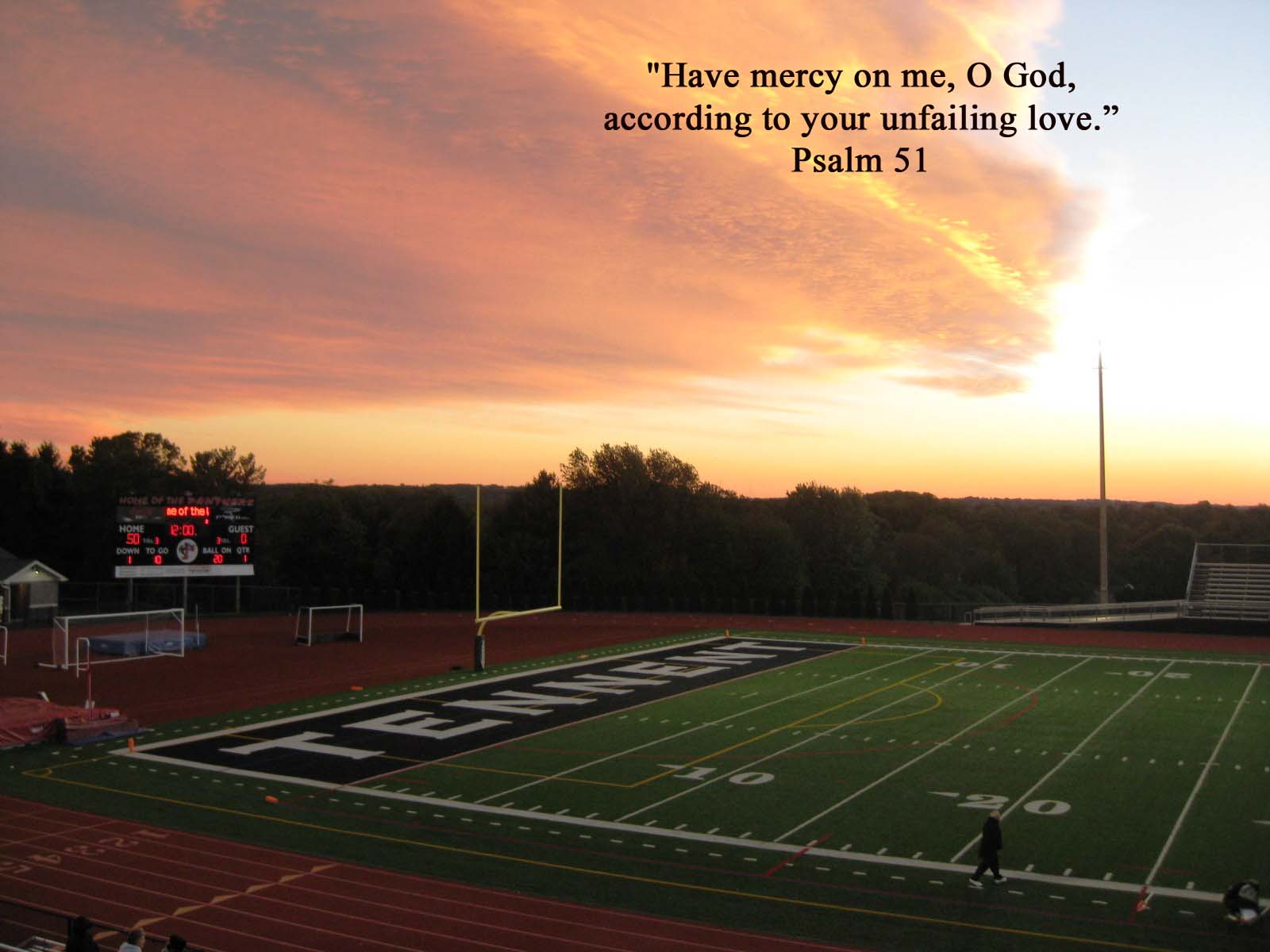
Athletes know when the battle’s been won. Football players realize there’s no need to ravage an inferior team. When the score reflects the opposition has no chance of winning, they precipitate the ending. The mercy rule specifies that the clock should keep running (except for limited reasons).  The intention is to put an end to the misery as soon as possible.

God has His mercy rule in place. Eternity’s clock is ticking. There will be an end to our misery here on earth. In the meantime Romans 8:37 assures us that, “We are more than conquerors.”

Yes, the battle has already been won. God has gained an overwhelming victory. Believers can rest in His promise and presence. We’ve been promised eternal life with Him in heaven. And if that’s not enough, we have His presence in the form of the Holy Spirit. His indwelling power helps us with our earthly trials.

When things get tough with MI, we wonder if God has left us. We ask, “Who shall separate us from the love of Christ? Shall trouble or hardship or persecution or famine or nakedness or danger or sword (Romans 8:35)?”

Romans 8:38-39 assures us no hardship—not even MI—will separate us from His love.

“For I am convinced that neither death nor life, neither angels nor demons, neither the present nor the future, nor any powers, neither height nor depth, nor anything else in all creation, will be able to separate us from the love of God that is in Christ Jesus our Lord.”

The mention of angels and demons reminds us there’s a spiritual battle being waged. God’s angels protect His people. Sometimes God sends a heavenly messenger. Like the one sent to Daniel. Here’s how Daniel described the divine interaction:

“Again the one who looked like a man touched me and gave me strength. ‘Do not be afraid, you who are highly esteemed,’ he said. ‘Peace! Be strong now; be strong.’ When he spoke to me, I was strengthened and said, ‘Speak, my lord, since you have given me strength (Daniel 10:18-19).’”

How did Daniel qualify for that celestial encounter? The messenger explained what Daniel had done to earn the honor.

“Since the first day that you set your mind to gain understanding and to humble yourself before your God, your words were heard, and I have come in response to them (Daniel 10:12).”

Heavenly Father,

I come before You humbly. I’m determined to fully understand Your victory. When all around looks dismal or when things seem out of control, help me remember Who’s fighting the battle. As Your messenger did for Daniel, strengthen me and give me Your peace. In Jesus’ name, Amen.

The more we reflect on God’s love and power, the more we find rest in Him. How can we even explain such love? By using surperlatives. Like Chris Tomlin did in his song ‘Indescribable.’

http://www.youtube.com/watch?v=gWdM4B1HEyI


R & R

Morris Arboretum Phila., PA

Morris Arboretum
Phila., PA

If you could escape, where would you go? My perfect escape would be back to the Land of Normal Livng. Wouldn’t you love to be treated to a trip to Normalcy? A place where you could spend carefree days soaking in relaxation. A place with no violence. No unexpected outbursts. No mental healthcare visits.

Thankfully God led us to a temporary oasis in our desert of mental illness (MI). This next chapter of our story demonstrates how God provided a season of rest and restoration. He revealed Chris’s resilience. Life seemed to be getting back to normal.

♦♦♦♦♦♦

In order to get released from the hospital, Chris did what he had to. During group sessions all the patients had to state how they wound up in the hospital. So Chris regularly told the staff he had assaulted his parents.

His three-week stay ended. It was time for Chris to go home. I wanted his bedroom and home to look warm and inviting. Our house had never been cleaned so thoroughly! We were thankful to have our son home again.

The summer after Chris’s junior year we traveled to Colorado. We had a wonderfully relaxing time. It was as if nothing had ever gone wrong. As if Chris hadn’t been sick at all. We went horseback riding, hiking, panning for gold, and mountain biking. Everything was perfect. Except when Robert was missing for a brief time. He had taken a wrong turn biking down a mountain in Vail.

“Where’s Robert?” I asked, bracing myself for the worst.

“Oh, he fell off the side of the mountain,” Howie explained casually.

Before my panic turned into hyperventilation, Robert appeared. Slightly scratched, but fine.

Shortly after our Colorado trip, both boys attended a music conference. They stayed overnight at a local college with 500 band leaders. Many of those attending the conference were drum majors. Chris had attended the training the year before. But this year would be different. This time he’d have to take his medication on his own.

I knew it would be a temptation for Chris not to take his medication. But he understood how important it was for him to take it. We trusted him to be responsible. And he was. Thankfully, Chris handled another major step in his recovery.

Chris had hoped one day he’d be the drum major of his marching band. He had a good chance to accomplish that goal …until he got sick. Even with his MI he still demonstrated all the necessary qualities of a drum major: excellent musical talent, remarkable marching skills, and strong leadership abilities.

But Chris’s breakdown didn’t just disrupt his life. It also shattered his dream of becoming a drum major. Yet, he still wanted to attend the conference. It made me so proud to see his resilience.

One of the events at the conference was a march off. That’s kind of like “Simon Says” only with someone calling out marching commands. If someone carries out a command incorrectly, he is eliminated. The competition continues until there is one winner left standing. Out of 500 drum majors Chris lasted until the last six. Only five others remained longer. God blessed him by letting him see he still had superior marching abilities.

After the boys returned from the music conference Chris had to fulfill his duties as a squad leader. I marveled at how clear thinking he was. He thought of every detail for the meetings. That involved offering rides to our house, planning refreshments, and preparing the agenda. Chris even organized a pizza party at a local restaurant for the freshman members. Senior band members were also invited to help the lower classmen get acclimated.

Chris’s senior year was fast approaching. We spent several days during the summer visiting colleges. Sometimes I wanted to continue on with our plans as though nothing had happened. But then I’d force myself to remember that something significant did happen.

We prayed for wisdom to know which colleges to investigate. Chris was very clear in what he wanted. His decisions made perfect sense. He wanted to go to a college with a fairly small campus that was about an hour and a half from home—far enough to live away from home, but still close enough to visit home frequently. He also wanted to attend a state university because that would be more affordable. He was especially interested in Penn State because of their famous Marching Blue Band. He hoped to join it during his junior year of college. Penn State also interested him because of their excellent business program. Chris planned on becoming an actuary.

Chris also applied to Kutztown State University. By October of his senior year he’d been accepted to both colleges.

What an awesome God we serve!!

During three weeks in the fall we hosted a German exchange student. Each weekend we took him to visit local tourist sites. It was a wonderful experience for all of us. We learned a lot and had a good time. The best part: life seemed so normal.

In the fall Chris got his driver’s license. He feared getting into a car accident. I worried that if he got into an accident he might not be able to handle it emotionally. Being in a car accident is upsetting enough for anyone, let alone someone who’s experienced MI.

If I were God, I’d make sure Chris would never have an accident.

Thankfully I’m not God. He chose to allow Chris to have a minor accident. He forced Chris to face his fears. There were no injuries. Chris hadn’t broken any laws. So Chris didn’t get a ticket. The car had plenty of damage, but Chris was fine emotionally. God reassured us Chris had become stronger emotionally.

Thank You, God, for protecting Chris and for helping us see his resilience.

During this time when Chris was feeling better he was able to articulate his experiences with MI. He could explain what it’s like to be paranoid and to be on Haldol.

“What’s it like to feel paranoid, Chris?”

“When I felt paranoid I hung onto one particular part of what someone was saying and focused on just that.”

“What’s it like to be on Haldol?” I wondered.

“It’s like having my body frozen or moving in slow motion while my brain was moving at a much faster pace.”

When it came time for County and District Band auditions Chris wanted to try out again. The year before was the “straw that broke the camel’s back.” The level of stress proved too much for him.

How can I tell him he shouldn’t audition? He’s a gifted musician. If I tell him he shouldn’t try out, he’ll think I’m trying to control him or treat him like a child. Or he might think I doubt his ability to handle it. He’d feel flawed emotionally. What if he tried out and lost it again?

We decided to let him try out. Soon our oasis would be gone. But God would see us through the next trial. Just as he does for all of us.

Don’t Give Up

leaf.drifting

Drifting…Lost Direction

Recently I’ve been feeling like a dead leaf. Lifeless and lacking purpose. Drifting without direction. Discouraged and defeated.

Surprisingly, raising a son with mental illness (MI) didn’t do me in. My multiple sclerosis (MS) hasn’t conquered me. My thwarted writing plans snarled me. Leaving me sinking in quicksand.

Strange how we can handle the big problems. And how smaller disappointments demolish our determination. So what was my final knock-down punch?

The marketing plan I created to promote my picture book hasn’t been yielding the intended results fast enough. My throne of self-sufficiency has crumbled.

Howie noticed my discouragement and lovingly said, “Don’t worry, Vic, we’ll figure it out.”

“I think that’s been my problem,” I replied. “I’VE been figuring it out. I need to figure HIM out.”

Since I can’t control the course of my MS or the symptoms of Chris’s MI, I’m starved for control. My problem has been this obsession to control things. I want to control SOMETHING in my life. Can you identify?

Our power to manage everything associated with MI is limited. MI prevents our kids from responding to our love.

Do you reach out to your child only to have him shut down? Is your comfort rejected?

Sometimes our well-meaning efforts backfire.

Do your peaceful words only enflame his anger? Does your child refuse to follow your advice? Do you intervene on your child’s behalf only to be misunderstood? Have you sought the advice of countless specialists only to have no clear diagnosis?

We encounter obstacles and dead ends.

What tempts you to give up? How many times can you get knocked down and rise again? How long can you support your child who has mental illness (MI) without seeing any improvement?

Quitting isn’t an option. What mother could ever abandon her most vulnerable child? So we try and try. Even though nothing seems to help our child with MI.

The eagle can provide insight into why our efforts fail. Instead of relying on its massive wingspan (average 6’ – 7.5’), it waits for the perfect conditions to step off its peak.

It soars and glides with less effort because it goes with the flow of God’s winds. Air currents, such as slope updrafts (winds that runs into a mountain and are forced to rise), enable the eagle to rise without flapping its wings. A massive eagle can simply float upward by catching a ride on rising bubbles of hot air called “thermals.”

eagle.soaring

Like the eagle, we can wait for God’s perfect timing. That will keep us from flapping in our own strength. We can depend on His power to carry us through the journey.

Those of us who are downcast have this promise: “Humble yourselves, therefore, under God’s mighty hand, that he may lift you up in due time. Cast all your anxiety on him because he cares for you. (1 Peter 5:6-7)”

Picture that. God’s hand cradling you. Then imagine Him gently lifting you up. In due time, He’ll uplift your countenance and soothe your emotions if you trust Him with all your cares. He’s sure to guide you along HIS path.

Feeling weary? Tired of the trial? In a pit of hopelessness? God’s Word promises you’ll soar like an eagle if you hope in Him.

“Those who hope in the Lord will renew their strength. They will soar on wings like eagles; they will run and not grow weary, they will walk and not be faint. (Isaiah 40:31)”

God saw my problem: the anguish of my soul.

“I will be glad and rejoice in your love, for you saw my affliction and knew the anguish of my soul. (Psalm 31:7)”

God provided the solution: the Anchor for my soul.

“We have this hope as an anchor for the soul, firm and secure. (Hebrews 6:19)”

Let’s trade anguish for the Anchor. Let’s not lose hope. Or give up. Let’s keep doing our best and trust God for the rest.

Following God’s lead through trials gets easier. His constant faithfulness demonstrates the Truth of His Word. His love never fails.

The group Jesus Culture reminds us in their song ‘One Thing Remains’ that God’s love, “never fails, never gives up, never runs out.”

http://www.youtube.com/watch?v=6_KXsMCJgBQ

Rescued

wave wave.2  wave.3

Listen to me!!! The sister of an unstable woman tried to warn police.  She told authorities that her sister was, “talking about demons prior to leaving the residence with her three young children.”

The NY Daily News article provides the account of what happened next. The police followed up and stopped Wilkerson’s car. They found no evidence of an unstable woman at the wheel. She appeared calm and the children seemed happy. The officer sent her on her way. Unfortunately, symptoms of mental illness (MI) aren’t always recognized by strangers—even officials.

Wilkerson’s sister had every reason to be concerned. She sensed doom.

Hours later, bystanders watched in horror as Wilkerson drove her SUV directly into the ocean. Witnesses heard the children’s screams for help and sprang into action. Ordinary onlookers sprinted toward the SUV.  Hurdling over waves, they reached the vehicle before it got swept into the ocean. Thankfully, those bystanders rescued all three children. Just before waves engulfed the vehicle and swept it away.

The outcome could have been tragic. Why didn’t the authorities heed the sister’s warning? Ineffective laws prevent authorities from taking action when a family member senses danger. Often the danger isn’t apparent to others.

When we’re brave enough to reach out to others, do they understand?  Usually not. How can they? Should we expect them to know what it’s like to live with someone who denies having MI and refuses treatment? Would they be able to comprehend our sense of helplessness? Sometimes relatives or church members even blame us for our child’s behaviors. Little do they know how much we invest into the lives of our kids with MI. How hard we try. How much we pray. How often we cry.

Some of us get to the point when we realize our own need for help. Does reaching out help? Sometimes. Some of us have found well-qualified health professionals. Perhaps you’re like many who have taken your child to several doctors and received a different diagnosis from each.

Or maybe you’ve mustered the courage to confide in others. Only to discover that even relatives or church members misunderstand. Instead of support, they pile on blame.

Are you tempted to drive into the ocean of despair? See Christ in your storm of life and reach out to Him.

Reaching out to God always helps! Our heavenly Father is in the business of rescuing His people. When Pharaoh’s chariots pursued the Israelites, God parted the Red Sea.

God’s people rejoiced and sang, “I will sing to the Lord, for he is highly exalted. Both horse and driver he has hurled into the sea.

“The Lord is my strength and my defense; he has become my salvation. He is my God, and I will praise him, my father’s God, and I will exalt him.

“Who among the gods is like you, Lord? Who is like you—majestic in holiness, awesome in glory, working wonders?

“The Lord reigns for ever and ever. (Exodus 15:1-2, 11, 18)”

Aaron Keyes wrote about God’s power in ‘Song of Moses.’ See if you can relate to those lyrics:

Though the storms of hell pursue, In darkest night we worship You

You divide the raging sea, From death to life You safely lead

 Oh praise the Lord our mighty warrior 

Praise the Lord the glorious one

By his hand we stand in victory

By his name we’ve overcome

Life will not engulf us. We will not drown in MI. In our darkest night we CAN worship Him. By His hand, we’ll stand in victory.

Let those lyrics minister to you.

http://www.youtube.com/watch?v=TI8yTeMv0Uo

Problems: Big or Little

problems

There’s a cure for minor irritations: big problems.

Raising a child who has mental illness (MI) puts things into perspective. Former annoyances pale in comparison to daunting trials.

I used to pride myself in being able to handle any problem. Until MI hit. When our son, Chris had his first psychotic episode, there was nothing I could do. I couldn’t restore clarity of thought.  Motherly comfort couldn’t cure him. Divine intervention was my only hope.

We sometimes have to get sucked into the quicksand of helplessness before we realize our need for God. Getting knocked flat on our back forces us to look up. Bringing into focus the Source of our help.

One day, while teaching second graders, I realized my reliance had completely shifted from my control to God’s. MI had taught me, “Don’t sweat the small stuff. It’s all small stuff.” It helped me understand that all our problems are small stuff to God.

Report cards were to be sent home. A major computer problem had been discovered. Forcing the school secretary to inform the teachers. She came to my classroom to report the bad news. The look in her eye told me she was bracing herself for a bad reaction.

“There’s a problem with the report card software program. A computer glitch is changing some of the grades. We don’t have time to double check all the grades for every student. Other teachers are really concerned. What do you think? Do you have any suggestions?”

I didn’t bat an eye. It didn’t faze me.

“This isn’t the end of the world. I think if people faced a real crisis, things would be put into perspective. This is no big deal. We can just send a note home informing the parents we’re aware of the problem. All we need to do is assure parents we’ll adjust any incorrect grades once we’ve had time to investigate.”

Don’t get me wrong. I wouldn’t want anyone to go through what we experienced with Chris. It’s just that a significant tragedy has a way of shifting our perspective.

In 1992 a monster storm threatened the southern tip of Florida. Hurricane Andrew quickly grew to a category five hurricane. My high school friend, Lynn, lived in Homestead with her family. Andrew was taking aim on her home. Homestead was in its direct path.

I called Lynn right before she evacuated. “I’ll pray for you and your family. What are you going to do?”

“We’re collecting photos and important papers. We’ll drive as far north as we can. We’ll be okay as long as we have each other.”

In the panic of the storm, it became clear to Lynn what was important. They could survive the loss of their home and business as long as they had each other.

When trials threaten to ravage our lives, we realize what’s important: family. When we’re at the mercy of circumstances, we understand our utter dependence on God. We realize our need to rely solely on Him.

Many parents dream their children will get a good job, marry, and have kids. Howie and I were no different … until MI hit. Now we’re grateful Chris is alive. Our greatest desire is for him to be happy and at peace.

Our dependence on God enables us to face another day. We don’t fear big problems because we know God is bigger. The more we see His faithfulness, protection, and provision, the more we can trust Him. We’ve learned to live with adversity, with an assurance of His care.

My former multi-handicapped student knew about living with adversity. I wondered what life was like for him. So I asked Tom, “What’s it like being blind?”

“It’s no picnic,” he casually remarked.

What an understatement! How could Tom answer so matter-of-factly? Because he’d faced his lifestyle for so long. He got used to it.

We’ve faced life with MI for over 17 years. I can agree with Tom. “It’s no picnic.” I’m not a fan of problems and life stressors. But problems don’t scare me anymore. I’ve grown accustomed to God’s intervention. And have learned to depend on His love and power in our lives.

The good news: God can give you that same blessed assurance.

This journey of MI can feel so lonely. But we’re never alone. God is with us. Joni Eareckson Tada, who has faced adversity for decades, sings of that great assurance. We’re ‘Alone Yet Not Alone.’

http://www.youtube.com/watch?v=BWVyVMbSzM4

Silence is Golden

silence

When words don’t seem to help our children with mental illness (MI), what can we do? Keep quiet. Silence is powerful. I learned that the hard way decades ago.

In college, my friend, Dave, got one of THOSE middle-of-the-night phone calls. The caller delivered heart-wrenching news.

Dave’s first reaction: he called me.

“Vicki, my best friend was killed in a car accident. I need to see you.”

Why is he calling ME? I suppose it’s because we share a strong faith in God. But I’ve never experienced the death of a loved one.

I sought advice from my roommate.

“Karen, the roommate you had for three years died suddenly last year. What should I say to Dave?”

Karen advised, “Nothing. Let him talk. Or just sit quietly with him. Share a hug and a tear.”

After college, my husband and I kept in touch with Dave and his wife, Trish. We were closer than friends— more like family. They had their first child, Ryan, around the same time we had Chris. Soon after, they had Kevin and we had Bobby.

One day, I got another call from Dave.

“Vicki, Ryan went to be with the Lord today. He drowned in our pool. We’re coming over.”

Ryan was only two years old.

My roommate’s wisdom helped once again. When they visited, we simply hugged, cried, and prayed. And listened to what they had to say. Dave shared even more disturbing information.

To add to the horror of it, we learned that Trish’s and Dave’s mother and father lost a child when they were young parents. Both sets of grandparents were reliving their own nightmare.

So when Ryan died, Dave sought advice from his father. “Dad, you’ve been through this.  What advice can you give me?”

He simply answered, “Son, you speak of your faith.  Now it’s time to use it.”

Another opportunity came for me to practice silence in the presence of someone grieving. I was the assistant director of an overnight week-long Christian summer camp for children with disabilities. One of the campers, Bruce, experienced a tragic loss just weeks before camp. His single mother died, leaving his aunt to raise him. The aunt chose to send Bruce to camp. Our staff had training and experience with children with intellectual disabilities. She hoped we could minister to Bruce.

Alex, Bruce’s counselor, sought my advice. “Bruce is having trouble getting to sleep at night. He just cries. What should I say to him?”

“Nothing. Just spend time with him. Silently pray for him.”

Those of us raising kids with MI sometimes feel helpless. We’re unsure how to help our vulnerable and fragile children. It’s comforting to know that our silence speaks volumes. It says, “I’m here for you.” Our gentle touch says, “I understand and care.”

What about our grief? It’s hard to see our loved one suffering. Why does God delay in helping our children?

The death of Lazarus provides an answer. Mary and Martha sought the Lord to heal their brother.

“Therefore the sisters sent to Him, saying, ‘Lord, behold, he whom You love is sick.’  When Jesus heard that, He said, ‘This sickness is not unto death, but for the glory of God, that the Son of God may be glorified through it.’  Now Jesus loved Martha and her sister and Lazarus. So, when He heard that he was sick, He stayed two more days in the place where He was. (John 11:3-6)”

The word ‘so’ can lead to some confusion about this story. The strange thing about the events in this scene is that Jesus remained where he was for two more days apparently because of His love for Mary, Martha, and Lazarus. If Jesus loved them so much, why didn’t he rush off right away? Jesus gave them a hint of the great work He would do and the reason for His delay: so ‘that the Son of God may be glorified through it.’

Jesus explained his delay again to his disciples.

“Then Jesus said to them plainly, ‘Lazarus is dead. And I am glad for your sakes that I was not there, that you may believe. Nevertheless let us go to him. (John 11:14-15)’”

When Jesus finally arrived on the scene, Lazarus had been in the tomb for four days.  Both his sisters struggled with a common torment many of us struggle with: If only…

“Now Martha said to Jesus, ‘Lord, if You had been here, my brother would not have died.’… Then, when Mary came where Jesus was, and saw Him, she fell down at His feet, saying to Him, ‘Lord, if You had been here, my brother would not have died. (John 11:21, 32)’”

But Jesus gently reminded them of the reason for His delay:

“Jesus said to her, ‘Did I not say to you that if you would believe you would see the glory of God? (John 11:40)’”

God is working out His perfect plan in His timing. He’s still in control. Even of the weather. Eastern US has gotten record amounts of snow this winter. Each snowfall is a reminder of our forgiveness. We stand before God ‘white as snow’ because of Christ’s blood. Reflect on His love as you listen to ‘White As Snow’ by Maranatha Singers.

http://www.youtube.com/watch?v=mmfwVYMu_Ow