Archives

Perspective

One Perspective

One Perspective

Another Perspective

Another Perspective


Finish this sentence: when it starts snowing, I …

Maybe you find delight and:

  • Pray for a day off from school
  • Go skiing
  • Earn tons of money removing it
  • Take pictures
  • Make a snowman

Or maybe you dread it and:

  • Scream, “Not again!!!”
  • Search for a sitter for the kids
  • Hurt your back shoveling

When I taught 2nd graders, faint snowflakes would spark an avalanche of excitement. Teachers would dread it. Students would love it.

The invasion of the frozen precipitation would threaten to sabotage my lessons. It often seemed as if the winter storm had blown their attention right out the window. I’d have a choice: to maintain my dismal perspective of the situation or join them in their delight.

I found it helped to adopt my students’ perspective. Rather than fight to win back their attention, I’d embrace their exhilaration. They simply needed the opportunity to release their enjoyment.

“Boys and girls, it’s snowing outside. We’re all going to celebrate at the same time. I’ll dismiss you row, by row. Once everyone is assembled by the window, I’ll open the curtains and we’ll all explode with enthusiasm. Get it out of your system so you can concentrate on your lessons when you return to your desks.”

Recently we got hit with another snowstorm. My first reaction was disgust.

Great. Now I’ll have to clean the snow off my car so I can get to the store.

With my car finally snowless, I was ready to get on with my errands. I grabbed my purse and also my camera.

Maybe I’ll want to take some pictures.

At first, all I noticed was the filthy dirty snow that lined the street. Definitely not a Kodak moment. I had to force myself to look beyond the cinder-splattered snow to find spotless snow scenes.

I wondered. Can we force ourselves to view our circumstances differently? Is it possible to find pleasant thoughts among the unhappy experiences of raising a child with mental illness (MI)? I think so.

If I was able to deliberately ignore the dirty snow and focus on the pure white snow, I can make a conscious effort to view my trials in a new way. I can occupy my thoughts with of MI, or look for God’s pure and perfect purpose in allowing it. I can search for His hand in the situation.

If we searched for Him in the trial, what would we find?

Like the Israelites, we’d become more certain that He is the LORD our God who brings us out from under our burdens.

“ ‘I will take you as My people, and I will be your God. Then you shall know that I am the LORD your God who brings you out from under the burdens of the Egyptians.’”  Exodus 6:7

Like the Israelites, we’d discover others seeing God’s power in our lives.

“for the LORD your God dried up the waters of the Jordan before you until you had crossed over, as the LORD your God did to the Red Sea, which He dried up before us until we had crossed over, that all the peoples of the earth may know the hand of the LORD, that it is mighty, that you may fear the LORD your God forever.”    Joshua 4:23-24

Like Christ’s disciples, we’d witness His works in afflictions.

“Now as Jesus passed by, He saw a man who was blind from birth. And His disciples asked Him, saying, ‘Rabbi, who sinned, this man or his parents, that he was born blind?’

“Jesus answered, ‘Neither this man nor his parents sinned, but that the works of God should be revealed in him.’”   John 9:1-3

Like the Mary and Martha, we’d see God glorified through the trial.

“When Jesus heard that, He said, “This sickness is not unto death, but for the glory of God, that the Son of God may be glorified through it.  Now Jesus loved Martha and her sister and Lazarus. So, when He heard that he was sick, He stayed two more days in the place where He was…Then Jesus said to them plainly, ‘Lazarus is dead. And I am glad for your sakes that I was not there, that you may believe. Nevertheless let us go to him.’”  John 11:4-6, 14-15

May God help you find Him throughout your day today.

More Powerful than Pain

Lord.goes.with.us

If you obey the speed limit, the road will sing to you.

Yeah, right.

Newsflash: Melodies motivate motorists.

It’s true. Musical highways are popping up around the world. Sound unbelievable? Check it out:

http://www.youtube.com/watch?v=LJgCLq4Qo6A&list=PL5kpImGdIpVSiMPZZTUYNJTjT_K7mi8jQ

Drivers will only hear the melody when driving at the correct speed. That’s the point. Curiosity may kill a cat, but it can save a motorist’s life. Maintaining safe speeds to ‘play’ the tune can prevent accidents.

Popularity of these roads is growing because people enjoy the creative prompting to follow speed limits. Wouldn’t it be nice if all warnings could be equally enjoyable?

Raising a child with mental illness (MI) can easily lead a mom to dangerous thoughts. Her heart can be filled with fear, worry, and cares. If allowed to fester, worse emotions can result. Like depression and despair. The Bible warns against such contaminated thinking. But how do we resist when life seems so out of control?

God Word is full of loving guidelines. Gentle warnings. Our loving Father couples don’ts with dos, offering us a way out. The biggest warning sign in scripture is hell. But God offers eternal life in heaven through Christ’s death on the cross. All we need to do is accept His free gift of salvation.

There are others:

Don’t fear:

“For the Spirit God gave us does not make us timid, but gives us power, love and self-discipline (2 Timothy 1:7).

Don’t fear losing control of your reactions. Do rely on His power, love, and self-discipline.

“There is no fear in love. But perfect love drives out fear, because fear has to do with punishment. The one who fears is not made perfect in love (1 John 4:18).”

Don’t fear what will become of your child. Do depend on His perfect love to drive out fear.

Don’t worry:

“‘Therefore I tell you, do not worry about your life… But seek first his kingdom and his righteousness, and all these things will be given to you as well. Therefore do not worry about tomorrow, for tomorrow will worry about itself. Each day has enough trouble of its own (Matthew 6:25, 33-34).’”

Don’t worry what tomorrow may bring. Do seek His kingdom and righteousness.

Don’t cling to cares:

“Humble yourselves, therefore, under God’s mighty hand, that he may lift you up in due time. Cast all your anxiety on him because he cares for you (1 Peter 5:6-7).”

Don’t hold onto your cares. Do give them to the One who cares for you.

Too often I plunge into my prayers with countless requests. Then I realized that’s not how I approach my son. I don’t start off all my conversations with. “Chris, take out the trash. Do the dishes. Fix my computer. Move that clutter to the shed. Clean your room…” Instead I say, “How are you?” I enter most conversations with a desire to find out more about him. My relationship with him isn’t based on what he will do for me. So why do I treat God like an almighty Santa Clause?

Christ had a reason for instructing us to begin our prayers with, “‘Our Father in heaven, hallowed be your name, your kingdom come, your will be done, on earth as it is in heaven (Matthew 6:9-10)’”.

He knew our need to shift our focus to Him. When we first contemplate His power, anxieties melt. Pain shrinks in the light of His greatness.

Come to Him first with love. Then the list.  

Many of us can relate to Peter who seemed to personify attention deficit hyperactivity disorder (ADHD). No wonder he offers great advice when we mess up. God doesn’t say, “Off to the dungeon with you!”

Instead, 1 Peter 4:8 reminds us, “Above all, love each other deeply, because love covers over a multitude of sins.”

So all we need to do is love (Ephesians 5:2), put on His armor (Ephesians 6:10-17), resist temptation (James 4:7) and draw near to His presence (James 4:8). That’s my formula for victorious living today.

Focus on Him and you listen to Matt Redman’s song ‘Blessed be Your Name.’

http://www.youtube.com/watch?v=PnWKehsOXu8


Signs of Joy

Chris.Vic.Christmas  Chris.waving

What’s my remote tail wager? My smile. When our cocker spaniel was alive I’d flash a full-teeth smile in his direction. Allegro’s tail would instantly wag like fast-speed windshield wipers. Then I’d switch to a tragedy-mask sad face. He’d match my expression by freezing his tail and dropping his head. I’d alternate the faces and get the same mirrored emotion from my pet. Happy face—wagging tail…Sad face—motionless tail.

My furry family member appeared to be able to detect my mood. But detecting a person’s mood isn’t so simple. A cheerful expression doesn’t always mean someone’s happy. Many smiles conceal the opposite emotion. Like Sunday church smiles intended to hide heartaches. Or professional smiles worn to impress. Or actor’s smiles used to entertain.

I never knew how much I missed Chris’s smile until a friend asked me a simple question.

“What makes Chris smile?” she asked.

Her words released a flood of tears. My emotional dam had been holding them back.

“I’ve stopped hoping to see him smile,” I responded, choking back tears.

A toddler’s smile can be trusted. Carefree joy flashes across their face as they delight in new experiences.

As a toddler Chris seemed to smile all the time.

“He seems like such a happy baby,” strangers would observe as they offered back a beaming grin. His contagious smile would light up their faces.

That was before bullying jolted the joy right out of him. Fellow classmates taunted him. Chris’s attention deficit hyperactive (ADHD) made him an easy target. Difficult peer interactions reduced the frequency of Chris’s smiles.

When mental illness (MI) hit Chris’s facial expression appeared lifeless. No smile. No curve to his mouth. Just a flat appearance. The sparkle in his eye was replaced with a dark, dead stare. Nowadays it’s rare to see him with a genuine smile. His occasional smiles look a bit strained. Like the Kodak moment kind of poses.

Mental illness (MI) can wipe away any pretense of happiness. Facial expressions can be windows into the soul. Especially when a person has MI. The pain is so great it’s reflected on the face. The mother longs to see signs of joy in the face of her child. How long can a mom endure seeing signs of turmoil, depression, or anxiety?

Can we find any comfort from the Bible? What can we learn from scripture? Proverbs tells us what we know. “A happy heart makes the face cheerful, but heartache crushes the spirit (Proverbs 15:13).”

We know MI can crush our child’s spirit. So the cry of our heart is for God to create in our child a happy heart. A clear-thinking mind. A peaceful spirit.

The Bible has much more to say about countenance than about smiles. That’s because smiles display superficial happiness. Genuine joy comes from deep within. It’s all about the heart.

King Artaxerxes understood that Nehemiah’s demeanor reflected his inner sorrow and said, “Why does your face look so sad when you are not ill? This can be nothing but sadness of heart (Nehemiah 2:2).”

The good news is that God can change hearts. He can do what we can’t.

What can we do? Proverbs 12:25 encourages us to speak kind words to our kids. We know they make a difference. That’s some comfort.

“Anxiety weighs down the heart, but a kind word cheers it up (Proverbs 12:25).”

We can also share Truth with our children, trusting that His Word will not return void. Here are just a few verses of peace, joy, and hope.

He’s promised peace:

“For he himself is our peace (Ephesians 2:14).”

“And the peace of God, which transcends all understanding, will guard your hearts and your minds in Christ Jesus (Philippians 4:7).”

“Now may the Lord of peace himself give you peace at all times and in every way. The Lord be with all of you (2 Thessalonians 3:16).”

“Peace I leave with you; my peace I give you. I do not give to you as the world gives. Do not let your hearts be troubled and do not be afraid (John 14:27).”

He restores joy:

“He fills your hearts with joy (Acts 14:17).”

He gives hope:

“You are my hope in the day of doom (Jeremiah 17:17).”

Dear Father, use these verses to comfort and heal our children.

Stability

God.stronghold

Why would thousands of commuters approve of the decision to shut down a bridge on a major highway? Is it because they look forward to adding more time to their already long drive into work? Could it be they eagerly anticipate the adventure of finding new routes amidst already clogged roads? Hardly! It’s because they understand the bridge is unstable. They fear what might happen. The tilting bridge could collapse.

That’s a picture of life in the home a child with mental illness (MI). Life with MI can be as flimsy as a house of cards. Normalcy and peace in the home can be as fragile egg shells. There’s instability and no one knows what might happen next. The uncertainty instills fear. Violence may or may not occur. But change is inevitable. That’s a troubling reality, a sad fact.  It’s hard for moms to accept their child won’t be the same. Can others understand?

Getting a new house, a new spouse, or a new job can be both fearful and wonderful. Wonderful because of the exciting adventure ahead. Fearful because of the changes that will occur. Change is unsettling to most people.

How can we cope? What can we do when we sense a new trial looming on the horizon?

This next part of our story provides one answer. I turned to my unchangeable Savior. Christ offered stability in the face of oncoming instability

♦♦♦♦♦♦

In March Chris behavior became alarming. He acted strangely, but different than the first time he suffered a psychotic episode. The first incident happened when he made an odd comment.

“I found the verse in the Bible about what should happen to a child who hits his parents,” he told me.

The verse in Exodus 21:15 came to my mind. ““Anyone who attacks their father or mother is to be put to death.”

“What did you think when you read that verse, Chris?”

“I think I got off easy,” he replied.

Chris still didn’t understand that his behavior was a result of his MI. Prior to his first psychotic episode he’d never been violent to us or anyone else. Quite the contrary. He was a loving and appreciative son. Often he’d thank me for making dinner.

That conversation signaled turmoil simmering inside Chris, tormenting him once again. I braced myself for another incident. Whatever that would be.

Early one week he didn’t communicate with us. He didn’t respond to our questions or share in our conversations.  He stopped smiling.  Within that week his behavior deteriorated quickly. New red flags popped up.

When I insisted he respond to us, he became belligerent.

“Don’t you ever shut up?” he’d ask.

Each day seemed worse. It took him longer and longer to respond.

“What did you say?” he sometimes asked.

I sensed he was having trouble thinking. It seemed hard for him to process information. Thankfully my teaching experiences helped me know how to respond. Some of my former students had significant processing delays in their thinking. They simply needed to hear a question repeated. So I’d repeat my questions to Chris slowly, using a minimum of words. Still he struggled to understand.

Everyone noticed Chris’s difficulty thinking. His brother, Robert, pointed it out. Chris’s teachers called to share their observations. The band director reported similar behaviors.

It progressed to the point that Chris wouldn’t even answer at all. No matter how many times we’d ask him something. No matter how slowly I’d post the question. Chris even started putting his fingers in his ears when I spoke to him.

“That’s typical teenage behavior,” some of my friends told me. Trying to comfort me.

I knew it was worse than typical teenage behavior. God gives mothers intuition and insight into their kids. Especially the most vulnerable ones.

Dear Father, I sense Chris is heading to another psychotic episode. Chris seems to be unraveling again. He’s become unstable again. Ease my anxiety.  I don’t know what we’ll be facing this time. Help me focus on Your stability in the midst of instability. Thank You that You never change. I know You’ll be faithful, just as you were last year. Once again I need Your peace, protection, and guidance.

The psychiatrist told us Chris was heading for different kind of psychotic episode. His first one caused his thoughts to race. This time his mind was slowing down.

By Thursday of that week Chris sat motionless with his head down. I knew I needed to take him to the psychiatrist.

“Chris you need to stay home tomorrow. I’ll take you to see Dr. Newman,” I informed him.

Chris silently refused. He just glared at me.

Reluctantly I allowed him to go to school. Friday was the day Chris’s physics teacher had breakfast with his students at a local diner. Our whole family frequently joined them. After breakfast Howie would take the boys to school on his way to the train station. I would drive my car to work. That morning the waitress was much slower than usual. In spite of that, the boys wanted to stay and finish breakfast.

“I’m not going to have time to take the boys to school. Can you drive them?” Howie asked me.

“I’ll drive you. Chris can take my car to drive himself and Robert to school,” I answered quickly. The time pressure caused me to make a poor decision. Chris was in no condition to drive.

When I got to work I did the final preparations for the Math and Bible Olympics. They were scheduled to be held that afternoon. I put in a call to the psychiatrist. Hoping he could prescribe a minor adjustment to Chris’s medication.

“Chris isn’t talking at all. He sits motionless with his head down. He even glared at me last night,” I reported

“I’m deeply concerned. I need to see him first thing tomorrow morning,” he said with urgency in his voice.

His tone scared me. Chris has the car. What if he completely loses it while driving home from school? I have to get to him as soon as possible.

The elementary school principal could fill in for me. She had helped with all the plans for the Olympics. The only problem was that she was pregnant. Due any minute.

“I need to meet Chris at his school before he leaves. I can get the Olympics started. Will you be able to run them?” I asked her.

“Sure. As long as I don’t go into labor!” she agreed.

Dear Father, please be the stability in this day. Keep her from going into labor. Prevent Chris from driving before I get to him.

I left work at 2:00 PM and flew to Chris’s school. I arrived there just before he left. And followed him home.

That night was Gym Night at the high school. All the students were divided into two teams (by last names, according to the alphabet). Chris had signed up for two events. One of them was Simon Says (much like the band march off). With him being son unstable, I was afraid of what he might do. I feared that if he got eliminated and the opposing team cheered, he would run to attack someone.

I watched him pacing before his events. Thankfully, he behaved normally during those events. As I watched him compete, his focus amazed me. It seemed impossible for him to hold it together under all the pressure of a gym filled with noisy spectators. Gym Night lasted several hours. All that time I studied Chris. Sitting poised and ready to leap off the bleachers if he acted peculiarly or violently.

Dear Father, please help Chris behave normally. My emotions are churned up. Please be the stability of my heart tonight.

Thankfully, the evening ended without incident. The next morning Howie and I drove Chris to see Dr. Newman. After one hour of observing and Chris and talking with us, Dr. Newman determined that Chris’s psychotropic medication was no longer working.

“We need to wean him off that medication and phase in another type of psychotropic medication,” he told us.  “This will be another very critical time. I can’t predict what will happen,” he warned. He then instructed us to, “Take Chris to see his psychologist today. Also get the paperwork started at the hospital in case Chris has to be admitted again. Call me if anything changes.”

I didn’t know what the future held for Chris. But it was enough that I knew Who held his future. God had been our stability during this instability. He’d continue to carry us through whatever was in store.

♦♦♦♦♦♦

Yes, life with MI can feel as flimsy as a house of cards. But God is our Rock and Stronghold.

“I love you, Lord, my strength. The Lord is my rock, my fortress and my deliverer; my God is my rock, in whom I take refuge, my shield and the horn of my salvation, my stronghold. I called to the Lord, who is worthy of praise, and I have been saved from my enemies (Psalm 18:1-3).”

Not Alone

Not.alone

Whoa! I didn’t see THAT coming!!!

Our lives had become less stressful and more uneventful. Chris seemed more stable. Life felt somewhat normal. The turbulence of Chris’s mental illness (MI) had disappeared. Or so I thought. It simply took up residence inside me! I never expected inner turmoil to hit me. Not when things seemed to be resolved. Chris had appeared to have recovered from his psychotic episode. God had helped me hold it together during the time Chris needed me. It made no sense that I’d start losing it for no apparent reason.

This part of our story illustrates how God met my personal needs. When loneliness and torment hit, God provided: freedom from my anguish, strengthening of my heart, restoration of my soul, protection of my sanity, assurances of His presence, and healing as a result of His comfort.

♦♦♦♦♦♦

MI had shaken our lives. But our household seemed to be recovering. We were picking up the pieces of our lives and moving on. Just like the calmness that follows an earthquake. But just like with an earthquake, I experienced aftershocks.

Merriam-Webster’s online dictionary defines ‘aftershocks’ as, “an aftereffect of a distressing or traumatic event.”

My mind, body, and emotions were reacting to the traumatic events surrounding Chris’s hospitalization. Painful reactions hit unexpectedly. Without obvious provocation.

December 1997 was a tough month for me. The holiday season brought many reminders of the previous year. Buying gifts, baking cookies, addressing cards, and … band rehearsals.

Something would trigger a memory and I’d experience a flashback. Before then, I didn’t know much about flashbacks. I had mistakenly thought flashbacks only happened to soldiers who had witnessed horrific things in battle. Suddenly they became very real. Too real. My mind and emotions would instantly be rocketed back to the Christmas season of 1996.

Like the time I attended a faculty meeting. Teachers were meeting with the music teacher to discuss details of the upcoming elementary Christmas program.

“First graders will be singing ‘Joy to the World’,” she explained.

She began playing the carol. Memories of Chris playing that song sabotaged my thoughts and emotions. All I could hear was his trumpet playing the tune in a distorted way. His voice, almost audible, echoed in my mind saying, “When I sound the trumpet by playing the song the right way, the world will end.”

The flashback unleased suppressed emotions. My heart began pounding. The dam, holding back months of tears, started to leak. Before it erupted, I quietly excused myself and headed for the nearest bathroom.

Obviously the year before I hadn’t processed what I’d seen. Hadn’t dealt with my emotions. No wonder. I had been consumed with helping Chris return to reality.

Flashbacks caught me by surprise. Causing my emotions to spill out. I found myself falling apart at unexpected times and inopportune places.  The more my mind periodically replayed awful scenes, the deeper my depression grew.

The enemy taunted me with fears that I might lose my own mind. But I trusted in the promise that, “The peace of God, which transcends all understanding, will guard your hearts and your minds in Christ Jesus (Philippians 4:7).”

Dear Father, Your Word says, “You will keep in perfect peace those whose minds are steadfast, because they trust in you (Isaiah 26:3).” Oh how I need Your perfect peace! Help me through my grief and flashbacks.

I rested in my firm belief that, “God has not given us a spirit of fear, but of power and of love and of a sound mind [Timothy 1:7 (NKJV)].”

A sound mind. That was my goal. God was the Glue that held me together. My divine Sanity Preserver prevented me from tumbling into a deep pit of inconsolable despair.

I felt exhausted all the time. So I ate foods with carbohydrates, hoping they’d give me the energy needed to face each day.

During this time of flashbacks and depression, sound sleep eluded me. I needed rest. Like God’s people who wandered forty years in the wilderness. God knew they were tired and fearful. So He gave Joshua the perfect words of encouragement for them. Joshua relayed the message and said, “Remember the command that Moses the servant of the Lord gave you after he said, ‘The Lord your God will give you rest by giving you this land.’”

When I read Joshua 1:13 it felt like God was speaking to me.

Thank You, Father, for Your promise to give me rest.

The familiar twenty-third Psalm offered new hope for me. It guaranteed my soul would be restored. And promised me His presence and comfort.

“He restores my soul;He leads me in the paths of righteousness for His name’s sake. Yea, though I walk through the valley of the shadow of death, I will fear no evil; Your rod and Your staff they comfort me [Psalm 23:3-4 (NKJV)].”

Each flashback threatened to break my heart once again.

“God, help me!” is all I could utter. Offering up the prayer of a drowning person. God threw me His Life Saver in the shape of Psalm 31:23-24.

“Oh, love the Lord, all you His saints! For the Lord preserves the faithful … Be of good courage, And He shall strengthen your heart, All you who hope in the Lord  (NKJV).”

Yes, Lord, my hope is in You. Thank You for hearing my cry. I praise You for strengthening my broken heart.

My carbohydrate diet led to weight gain. I gained lots of weight. That motivated me to go to Dr. Kent (the physician who first treated Chris when he became out of touch from reality).

“What can I do to deal with my fatigue?” I asked.

Knowing what I’d been going through with Chris he asked, “Is it possible you’re depressed?”

“I guess it’s possible,” I replied.

“I’ll write you a prescription for Prozac. That should help remove the cloud and help you sleep better.”

Reluctantly, I took the medication. If I’d learned nothing else, I’d learned to take MI seriously. Even my own depression.

Once the holiday season ended, I began feeling much better. As Dr. Kent predicted, the medication lifted the cloud and helped me sleep better. So I stopped taking the Prozac. There were a few more months before the next critical period. During those winter months, things remained uneventful with Chris.

Work got busier for me. In addition to my usual responsibilities as Director of Instruction and Director of Special Education, I was planning a Math and Bible Olympics for the school. Applications for new students began pouring in. With not enough time to do everything at work, I read the applications at home. I was back to spending time working at home. But this time I was careful to spend a more reasonable amount of time. Mindful of my need to stay focused on Chris’s well-being.

During that winter the Lord led several parents my way who had children with some sort of MI. Many of the mothers expressed trouble dealing with their situation. I wasn’t alone in my struggles.

One of our neighbors told me her daughter had symptoms of a head injury.

“Kelly has suffered a head injury. We don’t know what caused it. And we don’t know what the future holds for her. Life has become so uncertain.”

“I have some idea what you’re experiencing. Chris suffered a psychotic episode a year ago. His MI turned our lives upside down,” I confided.

My news helped the mother feel safe to admit the truth.

“Actually, the doctors told us Kelly’s symptoms are psychosomatic. They didn’t find any evidence that she suffered a head injury.”

“A psychiatrist would know what’s best for Kelly. Let me know if you want the name of a good psychiatrist.”

“I’m not convinced she didn’t have a head injury. Please don’t tell anyone what I’ve told you,” was her only reply.

Apparently the mother couldn’t deal with the thought of her daughter having MI. It seemed easier for her to continue believing the cause of the symptoms was related to a head injury.

Another mother told me she had to take medication to treat panic attacks.

“My son’s MI has caused me to get panic attacks,” she confided.

Several parents asked me for advice. Many wanted to know how to get their children with MI to agree to speak to a psychologist. One father of a teenage son with MI asked a slightly different question.

“My son isn’t happy with the psychiatrist he’s going to. His MI prevents him from going to school. If he discontinues treatment, he’ll never get back to school. What should I do?”

“Find another psychiatrist,” I answered.

He answered in an exhausted tone, “Yeah, I know that might help. I just can’t seem to find the time or the energy to even begin looking for another doctor.”

I completely understood.

Another husband and wife were contemplating putting their seriously depressed son in foster care. A mutual friend shared the news with me and added this judgmental statement:

“Can you believe they would even consider abandoning their own son?”

“Unless you’ve experienced what they’re going through, you can’t begin to understand what it’s like. You can’t possibly imagine what it’s like to have a child who is suffering from an illness you can’t see or measure. You can’t know the pain of having a child who rejects your love or attempts to nurture and comfort. And there’s no break to the misery. Because of the nature of MI, parents can’t get out together. They go months without any respite time for themselves.”

It helped to discover I wasn’t alone. Knowing others who were experiencing MI comforted me some. Not nearly as much as the realization that God was with me at all times. His constant presence comforted me. I found true rest and perfect peace in His presence.

His steadfast companionship yielded great strength and courage. I faced each new day with the assurance He’d be with me. When I started to feel emotionally fragile, Deuteronomy 31:6 restored my confidence. Reminding me to, “Be strong and courageous. Do not be afraid or terrified because of them, for the Lord your God goes with you; he will never leave you nor forsake you.” And He never left me.

♦♦♦♦♦♦

You may be experiencing flashbacks or struggling to recover from bad experiences with your child’s MI. Ask God for His grace by praying the words of Psalm 25:16-17.

“Turn to me and be gracious to me, for I am lonely and afflicted. Relieve the troubles of my heart and free me from my anguish.”




Musical Strain

Trouble.Spirit.black

It’s powerful. It can make people move, smile, sleep, or cry. And can change the mood of a crowd.  Music has power to influence emotions. David played his harp and freed Saul from a distressing spirit (1 Samuel 16:23).

According to Wikipedia, a musical strain is “a series of musical phrases that create a distinct melody of a piece.” Musical strain, in Chris’s case, represented stress that threatened his peace. Music contributed to his breakdown.

Being in several competitive bands is demanding. It requires endless practicing. It proved to be too much for Chris. But once he recovered from his psychotic episode, Chris wanted to return to his old routine. That included music competitions.

Chris had been released from the hospital and had finished his junior year. Thanks to gifted homeschool teachers, Chris completed his work on time and received good grades. Summer vacations to Colorado and leadership camp proved Chris was well on his way toward full recovery. But I still worried.

Chris has accomplished a lot since his breakdown. But he might still be emotionally fragile. I don’t think he’d be able to handle the stress of those music competitions. How can I allow him to subject himself to such pressure? How can I tell him not to audition?

God reminded me His power is greater than any musical composition. His perfect peace can block out the most disturbing music. Here’s how it happened:

♦♦♦♦♦♦

November was the month auditions were held for County Band (the best musicians in the county) and District Band (the best musicians in the area—several counties). That time of the month brought painful memories.

Just last year Chris auditioned for County Band and District Band. The day after his District Band try outs, he suffered his breakdown. Howie says we should let Chris enter the competition. I’ll ask everyone for prayer.

“Is it wise to let Chris do to the auditions?” many of my close friends would ask.

“If we don’t let him try out, he’ll feel more like a failure than if he auditioned and didn’t make it. He’d resent his mother controlling his life. I can’t refuse him the opportunity to demonstrate his incredible musical abilities. I don’t want to stand by and watch the added stress harm him again. That’s why I’m asking for prayer.”

We came up with a plan to support Chris as much as possible during the auditions. I made arrangements for Chris to see his psychologist immediately after the County Band auditions. Chris traveled to the auditions with his music director, Robert, and other students. I met him there and found the hosting school staff.

“My son, Chris, has a doctor’s appointment today. I’ll need to take him immediately after his audition,” I informed them.

Robert had to deal with his mother showing up at the auditions. Chris didn’t seem to mind. In fact, he welcomed my support. A reaction that both pleased me and concerned me.

District Band tryouts came next. Plans were put in place once again. I’d meet Chris at the school and take him to his appointment with the psychologist. I arrived at the school when all the students were warming up their instruments. The auditorium was filled with blaring, distorted sounds. The unrelated notes eerily resembled the “music” of a shattered mind.

What must this sound like to Chris? It can only amplify his apprehension and any distorted thought. I’ve got to get him out of this room!

I frantically searched for Chris. With a sense of urgency to free him of the noise. Usually it was easy to spot Chris because the slide of his trombone is easy to locate. Not this time. The longer it took for me to find him, the more I began to panic.

Where can he be? What’s happened to him? Was this a big mistake?

Finally I noticed him sitting on the edge of the stage. His head hung down and his shoulders were bent over. He was the only student not warming up. His pathetic appearance filled me with mixed emotions. Sorrow made my stomach feel like I’d just headed downward in a rollercoaster. But gratitude filled my heart.

I waded through the sea of instruments and musicians. When I reached him I asked, “Are you allowed to walk around?”

“Yeah. We can leave the auditorium.”

What a relief to reach the quiet, peaceful hallway. The Lord even helped me get permission for Chris to be tested earlier than scheduled.

While Chris was in a room being tested, two students walked by. They were saying unkind things about a fellow musician they’d seen last year.

“Do you remember that weird kid who acted so strange last year?” one asked.

“Yeah. He played the trombone. He was odd.”

They’re talking about Chris! I didn’t know he acted strangely last year. Not enough for others to notice. Father, why did I have to hear those unkind comments?

Thankfully, that audition ended without incident.

Soon after, we got the results. Robert and Chris made County Band. Chris also made District Band. Any musician would rejoice in such an accomplishment. In Chris’s case this represented a tremendous testimony of God’s provision. It was also proof of Chris’s determination, courage, and talent.

Dear Father,

Thank You for showing Chris that life can go on. I praise You that Your power is greater than anything. Dissonant music filled the room. But Your perfect peace inhabited Chris’s mind. You silence the discord in our hearts and our lives.


Sleep

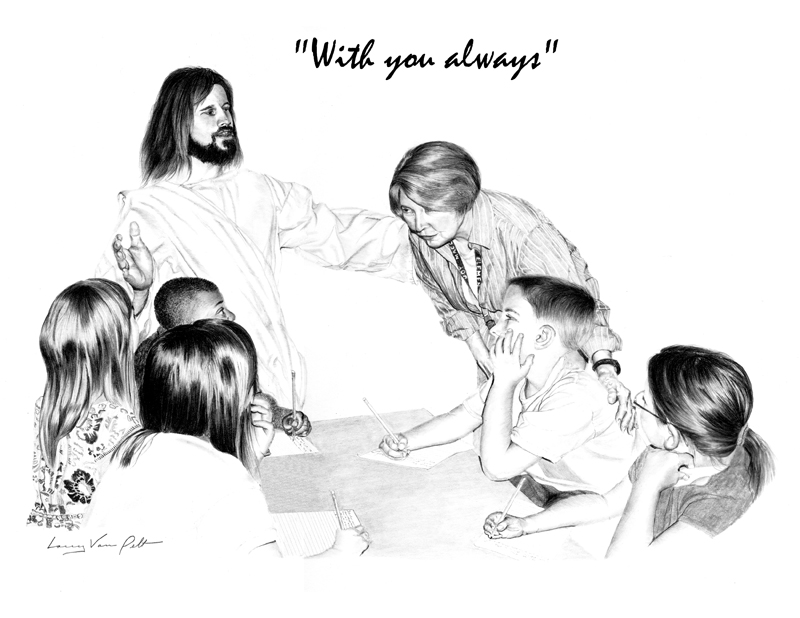
TeacherwithJesus

“What makes a good teacher a good teacher?” I asked my second grade students.

Some described the character of an excellent educator: “Nice, truthful, helpful, loving, responsible, respectful, patient, joyful, has the right opinions (not having bad opinions of people), and a good example.”

Others focused on the training and talents which produce a superior teacher: “Goes to college, knows how to teach, knows how to discipline (at the right time, giving consequences, letting the kids know that you still love them), good memory, makes good decisions, smart, observant, creative, and finds ways to make learning fun.”

A few provided adorable advice: “Pays attention to papers when grading, writes fast (for when students make lists), knows how to tell time, comes early and not late, and stays wake.”

Good to know: stay awake when teaching!  That last piece of advice conjured up visions of chaos.

chaos.classroom

We all know the drill: stay awake during work, sleep at night. Not everyone can sleep soundly. Some endure restless nights.

Mothers who have children with mental illness (MI) sometimes stay awake—all night. Too many nights. Praying or pondering. Wondering or waiting. Listening or crying.

Chris is a young adult. But I still have trouble falling asleep when he’s out. Sweet slumber eludes me amid tormenting thoughts. Where is he now? What is he doing? How is he acting? Are people being kind to him?

I fight those thoughts with prayer: Dear Father, protect Chris from anyone who would seek to harm him physically or emotionally.  

How can a mom turn off mothering? By turning it over to the One who never sleeps and leaving it in His hands.

“He will not let your foot slip—he who watches over you will not slumber; indeed, he who watches over Israel will neither slumber nor sleep. (Psalm 121:3-4)”

Sometimes I fall asleep praying for Chris. Other nights God’s promises comfort me.

“My eyes stay open through the watches of the night, that I may meditate on your promises.” Psalm 119:148

Do details of life with MI stalk you during the night? The Psalmist tells about his trouble: concerns which hounded him all night.

“When I was in distress, I sought the Lord; at night I stretched out untiring hands, and I would not be comforted. I remembered you, God, and I groaned; I meditated, and my spirit grew faint. I will remember the deeds of the Lord; yes, I will remember your miracles of long ago. I will consider all your works and meditate on all your mighty deeds. (Psalm 77:2-3, 11-12)”

Has MI rendered you inconsolable like the Psalmist? Follow his example and meditate on God’s past faithfulness. Reflect on His power and love.

Thoughts of His help translate into praise.

“On my bed I remember you; I think of you through the watches of the night. Because you are my help, I sing in the shadow of your wings. (Psalm 63:6-7)”

Are you literally afraid to go to sleep? Fearful of what might happen during the night. Picture His divine protection.

“In peace I will lie down and sleep, for you alone, Lord, make me dwell in safety. (Psalm 4:8)”

God promises to give you peaceful rest.

“When you lie down, you will not be afraid; when you lie down, your sleep will be sweet. (Proverbs 3:24)”

Maybe anxiety plagues you during your waking hours. Psalms assures you of His consolation.

“When anxiety was great within me, your consolation brought me joy. (Psalm 94:19)”

Dear Father, turn our restlessness into Your perfect peace. Help us leave our concerns at Your throne. In Jesus’ name, Amen.

Be still and find rest in Him as you listen to ‘Still’ by Hillsong.http://www.youtube.com/watch?v=yXywFuTf65I

Silence is Golden

silence

When words don’t seem to help our children with mental illness (MI), what can we do? Keep quiet. Silence is powerful. I learned that the hard way decades ago.

In college, my friend, Dave, got one of THOSE middle-of-the-night phone calls. The caller delivered heart-wrenching news.

Dave’s first reaction: he called me.

“Vicki, my best friend was killed in a car accident. I need to see you.”

Why is he calling ME? I suppose it’s because we share a strong faith in God. But I’ve never experienced the death of a loved one.

I sought advice from my roommate.

“Karen, the roommate you had for three years died suddenly last year. What should I say to Dave?”

Karen advised, “Nothing. Let him talk. Or just sit quietly with him. Share a hug and a tear.”

After college, my husband and I kept in touch with Dave and his wife, Trish. We were closer than friends— more like family. They had their first child, Ryan, around the same time we had Chris. Soon after, they had Kevin and we had Bobby.

One day, I got another call from Dave.

“Vicki, Ryan went to be with the Lord today. He drowned in our pool. We’re coming over.”

Ryan was only two years old.

My roommate’s wisdom helped once again. When they visited, we simply hugged, cried, and prayed. And listened to what they had to say. Dave shared even more disturbing information.

To add to the horror of it, we learned that Trish’s and Dave’s mother and father lost a child when they were young parents. Both sets of grandparents were reliving their own nightmare.

So when Ryan died, Dave sought advice from his father. “Dad, you’ve been through this.  What advice can you give me?”

He simply answered, “Son, you speak of your faith.  Now it’s time to use it.”

Another opportunity came for me to practice silence in the presence of someone grieving. I was the assistant director of an overnight week-long Christian summer camp for children with disabilities. One of the campers, Bruce, experienced a tragic loss just weeks before camp. His single mother died, leaving his aunt to raise him. The aunt chose to send Bruce to camp. Our staff had training and experience with children with intellectual disabilities. She hoped we could minister to Bruce.

Alex, Bruce’s counselor, sought my advice. “Bruce is having trouble getting to sleep at night. He just cries. What should I say to him?”

“Nothing. Just spend time with him. Silently pray for him.”

Those of us raising kids with MI sometimes feel helpless. We’re unsure how to help our vulnerable and fragile children. It’s comforting to know that our silence speaks volumes. It says, “I’m here for you.” Our gentle touch says, “I understand and care.”

What about our grief? It’s hard to see our loved one suffering. Why does God delay in helping our children?

The death of Lazarus provides an answer. Mary and Martha sought the Lord to heal their brother.

“Therefore the sisters sent to Him, saying, ‘Lord, behold, he whom You love is sick.’  When Jesus heard that, He said, ‘This sickness is not unto death, but for the glory of God, that the Son of God may be glorified through it.’  Now Jesus loved Martha and her sister and Lazarus. So, when He heard that he was sick, He stayed two more days in the place where He was. (John 11:3-6)”

The word ‘so’ can lead to some confusion about this story. The strange thing about the events in this scene is that Jesus remained where he was for two more days apparently because of His love for Mary, Martha, and Lazarus. If Jesus loved them so much, why didn’t he rush off right away? Jesus gave them a hint of the great work He would do and the reason for His delay: so ‘that the Son of God may be glorified through it.’

Jesus explained his delay again to his disciples.

“Then Jesus said to them plainly, ‘Lazarus is dead. And I am glad for your sakes that I was not there, that you may believe. Nevertheless let us go to him. (John 11:14-15)’”

When Jesus finally arrived on the scene, Lazarus had been in the tomb for four days.  Both his sisters struggled with a common torment many of us struggle with: If only…

“Now Martha said to Jesus, ‘Lord, if You had been here, my brother would not have died.’… Then, when Mary came where Jesus was, and saw Him, she fell down at His feet, saying to Him, ‘Lord, if You had been here, my brother would not have died. (John 11:21, 32)’”

But Jesus gently reminded them of the reason for His delay:

“Jesus said to her, ‘Did I not say to you that if you would believe you would see the glory of God? (John 11:40)’”

God is working out His perfect plan in His timing. He’s still in control. Even of the weather. Eastern US has gotten record amounts of snow this winter. Each snowfall is a reminder of our forgiveness. We stand before God ‘white as snow’ because of Christ’s blood. Reflect on His love as you listen to ‘White As Snow’ by Maranatha Singers.

http://www.youtube.com/watch?v=mmfwVYMu_Ow

Real or Unreal

Macaw

The Macaw caught my eye. Was it real or stuffed? Soon I found out.

The aisles in the tropical bird store were crammed with supplies for bird-lovers. I stepped back to snap a picture of the feathery creature and knocked into a shelf of feeders. “Uh-oh,” flew out of my mouth proclaiming my fear that they’d all topple over.

“Uh-oh,” echoed back.

Did I just hear that? To confirm my suspicions, I repeated my reaction. “Uh-oh.”

“Uh-oh,” bellowed back the refrain from the perch. That parrot, asserted itself by honking, “Uh-oh!”  As if mocking my clumsiness. Proclaiming my private mistake to the entire store.

Thankfully, a parrot can’t repeat unspoken words. Ideas hidden in peoples’ minds are safe.

“A penny for your thoughts.”  Would you reveal your most intimate thoughts so cheaply?

That phrase won’t necessary buy accurate information from a child with mental illness (MI). You might only get silence or a glare.

Years ago, when I attended part of Chris’s appointments with his psychologist, the doctor would ask, “So Chris, what are you thinking?”

Chris often looked at me as if to say, “I’m not gonna say anything with her here. My thoughts are private.”

Can you blame him? Would you willingly reveal your every thought? Certainly not the ugly ones.

Thankfully, most of us can suppress vindictive, angry, impure or judgmental thoughts. We put the mental brakes on opinions that threaten to contaminate our conversations. We resist the temptation to blurt out impressions like, “Wow! I can’t believe she …” We stifle our speech when feeling, “I wish he would just …”

Foreign thoughts that invade our thinking are annoying. It could be worse. What if we couldn’t trust our thoughts? That would be horrifying. That’s what it’s like for individuals with MI who hear voices. It’s difficult, if not impossible, to distinguish real from unreal.

We can help children who hear voices by suggesting how to distinguish between real and unreal. Those that spew hurtful or hateful messages are most likely not real; they’re symptoms of MI. The best offense is to fill their minds with undeniable Truth. God is real. He loves them.

We need to remind ourselves of that fact. God is real. And His love for us is very real.

Troubles seem to stalk our families. Bazaar behaviors become the norm. We seem to stumble through dark days searching for an ounce of hope. Praying for normalcy.

I don’t know about you, but there were days I thought I’d simply ignore the reality of MI in my life. As if I could will it away with positive thoughts.

Today, I’m going to be at peace.

But anxious thoughts would ambush my plan. Worries would pounce on my artificial peace. And pound away at my awareness of His presence. Sometimes I’d experience more subtle attacks. My focus would meander throughout the day. Carefree thoughts would focus on this chore and that errand. Then curiosity would lure me down dark paths in my mind.

I wonder if Chris is sitting alone at lunch. Did he remember to ask the teacher for testing in a quiet setting?

Such seductive contemplation would suddenly entrap me. I’d find myself snarled in my own deception.

Chris can’t be okay because no one is there to help him.

Then I’d come to my senses and remember God wouldn’t abandon Chris. At those times, I refused to allow concerns to trample my trust in Him.

How could my trust in God be unshakable? Because of who He is.

In my training to be a vision support teacher, I had to experience what it’s like to be blind. The professor instructed me to wear a blindfold and follow a sighted guide. My level of trust depended on the person leading. If I knew he’d protect me from injury, I relaxed. If my guide had difficulties paying attention, I peeked under my blindfold. Knowing I had to depend on myself.

The more I know of God and His love for me, the more I can rest in His care. I assure myself: “Yes, my soul, find rest in God; my hope comes from him. Truly he is my rock and my salvation; he is my fortress, I will not be shaken. (Psalm 62:5-6)”

Thank You, Father, that You’re very real. Your Word is true and I can depend on Your love. Make Your presence known to me today in greater ways. Align and synchronize my thoughts with Yours.

God answers, “So do not fear, for I am with you; do not be dismayed, for I am your God. I will strengthen you and help you; I will uphold you with my righteous right hand. (Isaiah 41:10)”

Rejoice in His strength as you listen to Hillsong’s ‘Believe.’

http://www.youtube.com/watch?v=kbIXoPblF8Q

Emotional Pain of Bullying


Vicki's Picture Book

Vicki’s Picture Book

“What if my son wasn’t bullied?”

Is that thought among your what ifs? Do you wonder what role bullying played in your child’s mental illness (MI)? Thinking maybe bullying caused it.

Bullying is painful for the target and for the victim’s mother.

Our son, Chris, was the object of bullying throughout school. His ADHD made him an easy target. Other kids knew how to torment him in class without getting caught. If Chris told them to stop, he’d be the one to get in trouble for disrupting the class. His belongings were often taken from him. Kids teased him at recess. Even beat him up. He got so taunted on the bus that I drove him to and from school.

As he got older, it got worse. In sixth grade Chris became a latch-key kid. My new job prevented me from driving him to and from school. He had to take the bus. When he got off the bus, children harassed him. The school district said there was nothing they could do. The police advised against taking action. Saying it would only enflame the situation. So each day when I came home I’d check him for bruises. Then I’d comfort him and repair his damaged self-esteem.

Just when things seemed like they couldn’t get worse, they did. In high school he joined the marching band. I often watched his peers walk past him as if he didn’t exist. A form of bullying that says, “You’re not worthy enough to be acknowledged.” Someone even pulled a knife on him. In college a teacher whacked him on the head with a book because he slept in class. NOTE: His medication made him drowsy.

Undoubtedly, bullying impacts mental health. The website stopbully.gov addresses the effects of bullying. They state, “Bullying is linked to many negative outcomes including impacts on mental health …”

Some children are bullied more than others. Even just one traumatic event can scar someone emotionally. It’s time to update the old adage: “Sticks and stones may break my bones, but names will never FOREVER hurt me.” Emotional scars can last a lifetime.

Ask my mother-in-law, Mary. When she was alive, she frequently told the story of an incident that happened when she was eight years old.

At home, her parents spoke Ukrainian. So, Mary pronounced ‘soup’ by saying ‘zoup.’ In second grade she told her teacher, “I’m having zoup for lunch.”

Her teacher asked her to repeat what she said.

Mary repeated it and the entire class laughed at her. Including the teacher.

Mary told that story over and over again … even 85 yrs. after it happened.

Bullying has impacted my life as a bystander, parent, educator, and administrator. That’s why I wrote a picture book to empower bystanders. Children who witness bullying are often too intimidated to tell an adult. There seemed to be a need for a book to help bystanders. One that parents and educators could use to teach bystanders what they can do to prevent bullying. Heart Eyes: Beth and the Bullies is now available on Amazon in print or as an eBook.

What’s the worst kind of bullying? Would it be when someone is threatening a person’s life? Imagine if your best friend’s father was trying to kill you? In the Bible we read about David. His best friend’s father, Saul, repeatedly tried to kill David.

David didn’t understand why he was so persecuted. He asked his best friend, “What have I done? What is my crime? How have I wronged your father, that he is trying to kill me?”  (1 Samuel 20:1)

Later in 1 Samuel 30:4 we read how things got so bad that, “David and his men wept aloud until they had no strength left to weep.”

Have you ever cried that much over the tragedy of your child’s life?

The same God who protected David’s life can minister to you. David strengthened himself in the Lord his God (1 Samuel 30:6). Find inner strength in the Lord your God.

We can praise God in our storm because we know He’s with us. ‘Praise You in the Storm’ by Casting Crowns reminds us of that truth.

http://www.youtube.com/watch?v=vCpP0mFD9F0